
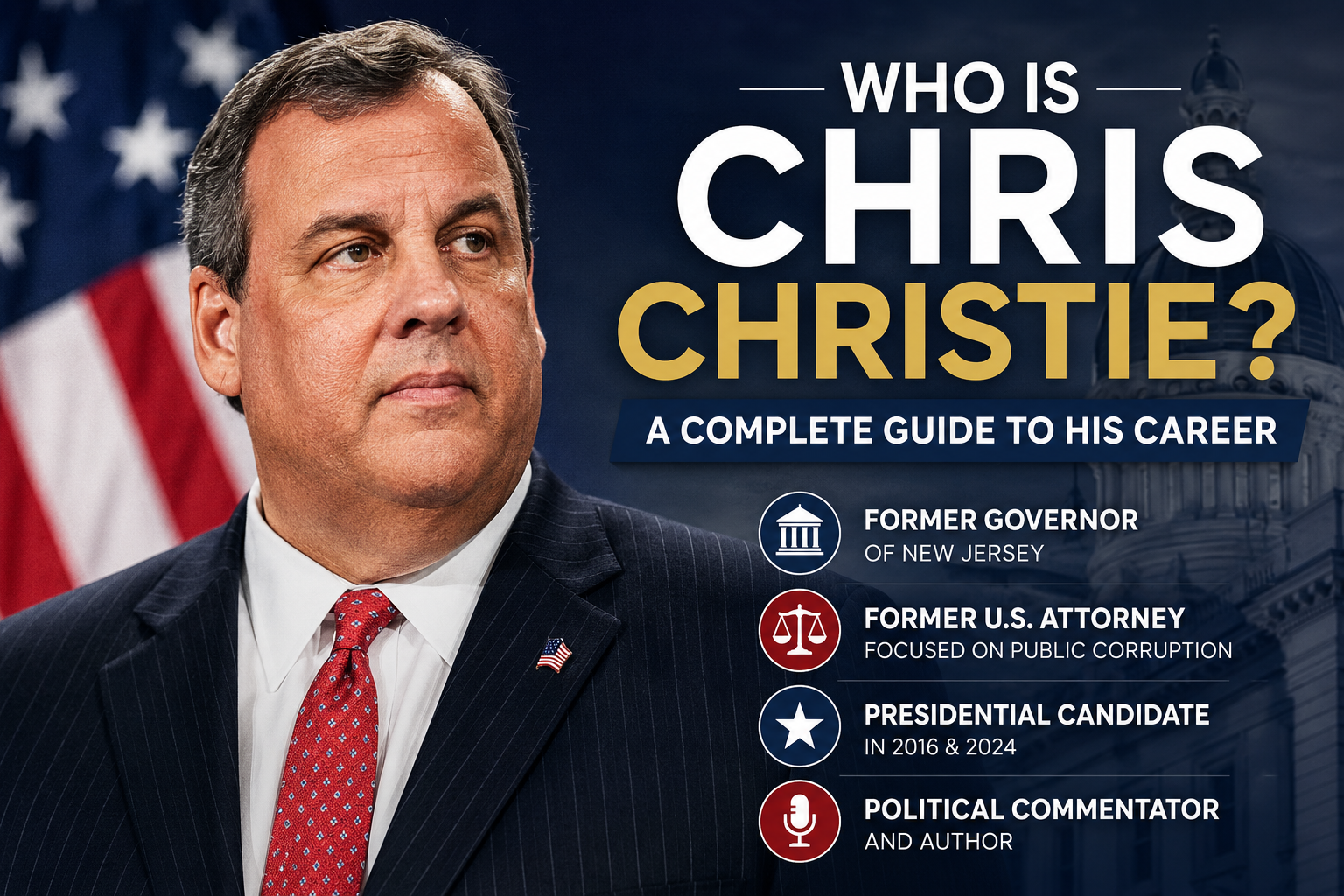
Who Is Chris Christie? A Complete Guide to His Career
Chris Christie is one of the most recognizable figures in modern American politics. Known for his direct communication style and years of public service, he has served as a federal prosecutor, Governor of New Jersey, presidential candidate, and political commentator. Throughout his career, Christie has attracted both strong support and significant criticism, making him an influential and often debated public figure.
Whether you’re researching his political career, leadership style, or personal background, understanding Chris Christie’s journey provides valuable insight into recent American political history. This guide explores his biography, achievements, controversies, and lasting impact in a clear and balanced way.
Key Takeaways
- Chris Christie served as the 55th Governor of New Jersey from 2010 to 2018.
- Before entering state politics, he worked as a U.S. Attorney focused on public corruption cases.
- He ran for the Republican presidential nomination in both 2016 and 2024.
- Christie became nationally known for his outspoken leadership and bipartisan approach during major crises.
- His political legacy includes both notable accomplishments and high-profile controversies.
Biography Table
| Information | Details |
|---|---|
| Full Name | Christopher James Christie |
| Date of Birth | September 6, 1962 |
| Age | 63 (as of 2026) |
| Birthplace | Newark, New Jersey, United States |
| Nationality | American |
| Profession | Politician, Attorney, Political Commentator |
| Education | University of Delaware; Seton Hall University School of Law |
| Years Active | 1990s–Present |
| Known For | Governor of New Jersey, Presidential Campaigns |
| Major Achievements | Governor of New Jersey, U.S. Attorney for New Jersey, Republican Presidential Candidate |
| Estimated Net Worth (Approximate) | Public estimates vary; no officially confirmed figure |
Chris Christie Biography
Early Life and Education
Chris Christie was born in Newark, New Jersey, and grew up in Livingston. Raised in a middle-class family, he developed an interest in government and public service at a young age.
He attended the University of Delaware, earning a degree in political science before continuing his legal education at Seton Hall University School of Law. After graduating, Christie entered private legal practice, building experience that later supported his transition into public service.
Beginning His Legal Career
Before becoming a household name in politics, Chris Christie established himself as an attorney. His legal background proved essential throughout his public career.
A major turning point came in 2002 when he was appointed U.S. Attorney for the District of New Jersey. During his tenure, Christie focused heavily on combating public corruption, financial crimes, and organized crime.
His office secured numerous convictions involving public officials from both major political parties, helping build his reputation as a prosecutor willing to pursue complex cases regardless of political affiliation.
Chris Christie as Governor of New Jersey
Election Victory
Chris Christie was elected Governor of New Jersey in 2009 and took office in January 2010. His campaign centered on government reform, fiscal responsibility, and reducing state spending.
He won reelection in 2013 by a wide margin, attracting support from Republicans, independents, and some Democratic voters.
Major Priorities
As governor, Christie focused on several major policy areas:
- Budget reform
- Pension and healthcare changes
- Property tax issues
- Education reform
- Infrastructure improvements
- Economic development
Supporters praised his willingness to make difficult financial decisions, while critics argued that some reforms negatively affected public employees and state services.
Leadership During Hurricane Sandy
One of the defining moments of Chris Christie’s governorship came during Hurricane Sandy in 2012.
The devastating storm caused widespread destruction across New Jersey. Christie received national attention for coordinating emergency response efforts and working closely with federal officials regardless of political differences.
His visible leadership during the crisis earned praise from many observers, although political debates later emerged regarding recovery funding and long-term rebuilding efforts.
Presidential Campaigns
The 2016 Campaign
Chris Christie announced his candidacy for the Republican presidential nomination in 2015.
His campaign emphasized:
- National security
- Government experience
- Fiscal discipline
- Criminal justice knowledge
Although Christie performed strongly in several debates, he suspended his campaign after the New Hampshire primary.
He later endorsed Donald Trump, a decision that became one of the most discussed moments of his political career.
The 2024 Campaign
Years later, Christie entered the Republican presidential race again.
His second campaign focused heavily on:
- Conservative governance
- National debt
- Constitutional principles
- Criticism of political polarization
Although he remained an influential voice during the campaign, he ultimately did not secure the party’s nomination.
Chris Christie’s Leadership Style
One reason Chris Christie became nationally recognized was his communication style.
Characteristics frequently associated with his leadership include:
| Strengths | Criticisms |
|---|---|
| Direct communication | Sometimes viewed as confrontational |
| Strong crisis management | Polarizing public image |
| Willingness to negotiate across party lines | Frequent political conflicts |
| Experience in law enforcement | Tough governing style |
His supporters appreciate his willingness to answer difficult questions directly, while critics believe his approach occasionally created unnecessary political tension.
Major Achievements
Chris Christie’s career includes several notable accomplishments.
Anti-Corruption Work
As U.S. Attorney, he supervised investigations that resulted in numerous public corruption convictions.
Budget Reforms
His administration introduced spending controls and attempted long-term fiscal reforms aimed at improving New Jersey’s financial position.
Emergency Response
His handling of Hurricane Sandy remains one of the most recognized examples of executive leadership during a state emergency.
National Political Influence
Even outside elected office, Christie has remained an influential commentator on national politics, appearing regularly in television interviews and political discussions.
Challenges and Controversies
Like many prominent political figures, Chris Christie’s career has included controversy.
Bridgegate
Perhaps the best-known controversy involved lane closures near the George Washington Bridge in 2013.
Although Christie denied directing the closures and was not charged with wrongdoing, the incident significantly affected public perceptions of his administration.
Budget Debates
Critics questioned some of his fiscal decisions, arguing that long-term financial challenges remained despite spending reforms.
Political Relationships
Throughout his career, Christie developed alliances and rivalries across the political spectrum, sometimes drawing criticism from members of both major parties.
Chris Christie Beyond Politics
Outside government, Christie has remained active through media appearances, public speaking, and political analysis.
He has authored books discussing leadership, politics, and public service, providing readers with his perspective on governing and decision-making.
He also frequently participates in television discussions covering elections, public policy, and current political developments.
Chris Christie’s Political Legacy
Chris Christie’s influence extends beyond New Jersey.
His career reflects several broader themes in American politics:
- Bipartisan cooperation during emergencies
- Debate over government spending
- Anti-corruption efforts
- Strong executive leadership
- Evolution of the modern Republican Party
Historians and political analysts continue to evaluate his long-term impact, particularly regarding fiscal policy, crisis management, and national political discourse.
Interesting Facts About Chris Christie
- He served two terms as Governor of New Jersey.
- Before politics, he spent years practicing law.
- Christie became one of the nation’s youngest U.S. Attorneys when appointed.
- He has written books on politics and leadership.
- He remains an active commentator on American political affairs.
Chris Christie Career Timeline
| Year | Milestone |
|---|---|
| 1962 | Born in Newark, New Jersey |
| 1984 | Graduated from the University of Delaware |
| 1987 | Earned law degree from Seton Hall University |
| 2002 | Appointed U.S. Attorney for New Jersey |
| 2009 | Elected Governor of New Jersey |
| 2013 | Reelected Governor |
| 2015 | Announced first presidential campaign |
| 2023 | Announced second presidential campaign |
Frequently Asked Questions
Who is Chris Christie?
Chris Christie is an American attorney, politician, and former Governor of New Jersey who has also sought the Republican presidential nomination and worked as a political commentator.
How long was Chris Christie governor?
He served two terms as Governor of New Jersey from January 2010 through January 2018.
What political party does Chris Christie belong to?
Chris Christie is a member of the Republican Party.
What is Chris Christie best known for?
He is widely known for serving as Governor of New Jersey, leading the state’s response to Hurricane Sandy, and running for president.
What did Chris Christie do before politics?
He practiced law and later served as the U.S. Attorney for the District of New Jersey, where he focused on corruption and financial crime cases.
Did Chris Christie run for president?
Yes. He sought the Republican presidential nomination in both the 2016 and 2024 election cycles.
What is Chris Christie’s leadership style?
He is generally known for direct communication, decisive decision-making, and a willingness to engage in bipartisan cooperation when addressing major public issues.
Conclusion
Chris Christie has built a career that spans law, state government, national politics, and public commentary. From prosecuting corruption cases to leading New Jersey through significant challenges, his public service has left a lasting mark on American politics. While opinions about his policies and leadership differ, his influence on political debate and governance remains undeniable. Whether viewed as a reform-minded executive, a presidential candidate, or a prominent political voice, Chris Christie continues to be an important figure in discussions about leadership, public service, and the evolving landscape of U.S. politics.











Leave a Reply