
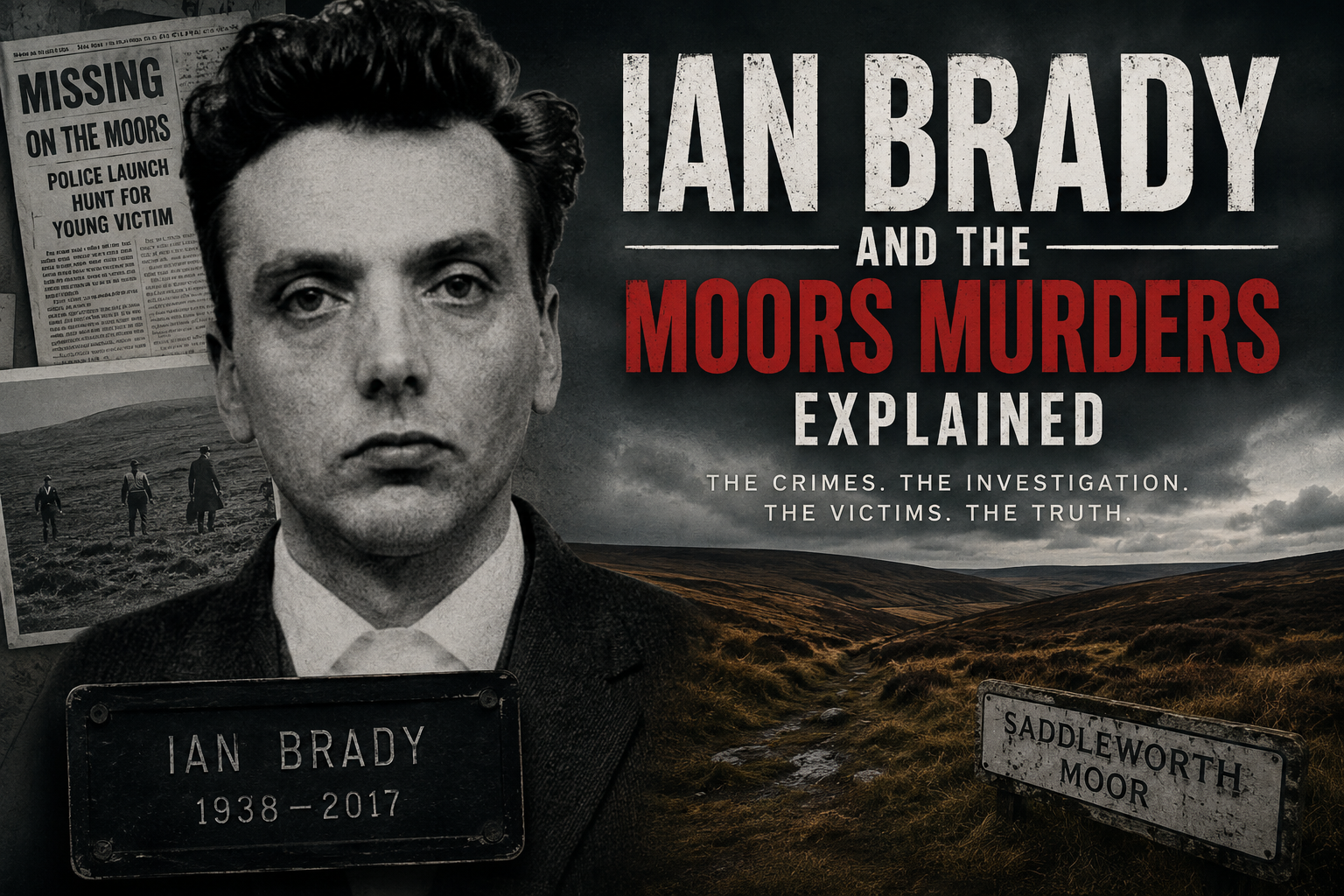
Ian Brady and the Moors Murders Explained
Ian Brady remains one of the most infamous criminals in British history. Alongside Myra Hindley, he was responsible for the Moors Murders, a series of child murders that shocked the United Kingdom during the 1960s and forever changed public attitudes toward violent crime.
More than half a century later, the case continues to attract attention because of its brutality, the long search for victims, and the lasting impact it had on law enforcement, criminal justice, and the families affected. Understanding Ian Brady means looking beyond sensational headlines and examining the facts, the investigation, the legal proceedings, and the legacy of one of Britain’s most notorious murder cases.
This article provides a complete overview of Ian Brady, his background, the crimes, the investigation, the trials, and why the Moors Murders remain one of the darkest chapters in British criminal history.
Key Takeaways
- Ian Brady was one of the perpetrators of the Moors Murders in England during the 1960s.
- He committed the crimes with accomplice Myra Hindley.
- The murders had a profound impact on British policing and criminal investigations.
- Several victims were buried on Saddleworth Moor, making recovery efforts especially difficult.
- The case remains one of the most studied criminal investigations in modern British history.
Biography Table
| Information | Details |
|---|---|
| Full Name | Ian Duncan Stewart Brady |
| Date of Birth | January 2, 1938 |
| Birthplace | Glasgow, Scotland |
| Nationality | British |
| Profession | Criminal |
| Years Active | 1963–1965 (criminal offenses) |
| Known For | Co-perpetrator of the Moors Murders |
| Major Achievements | None |
| Date of Death | May 15, 2017 |
Main Article
Who Was Ian Brady?
Ian Brady was born in Glasgow, Scotland, and spent much of his childhood in foster care. His early life has often been examined by criminologists seeking to understand factors that may have influenced his later behavior. While difficult childhood experiences are sometimes discussed in relation to criminal psychology, they do not explain or justify his crimes.
As a young adult, Brady moved to Manchester, England, where he worked as a stock clerk. It was there that he met Myra Hindley, who became both his romantic partner and criminal accomplice.
Their relationship would become central to one of Britain’s most horrifying murder cases.
The Moors Murders
The term “Moors Murders” refers to the murders of five children committed between 1963 and 1965.
The known victims were:
- Pauline Reade
- John Kilbride
- Keith Bennett
- Lesley Ann Downey
- Edward Evans
Most of the victims were buried on Saddleworth Moor in northern England, giving the crimes their name.
The disappearance of these children created widespread fear throughout the region and generated enormous media attention.
Ian Brady and Myra Hindley
Brady and Hindley worked together in planning and carrying out the murders.
Although their exact individual roles have been debated over the years, both were convicted for their involvement.
Investigators later concluded that Brady exercised considerable influence over Hindley, though courts ultimately held both fully responsible for their actions.
The partnership became one of the most notorious criminal collaborations in British history.
Timeline of the Crimes
| Year | Event |
|---|---|
| 1963 | Pauline Reade murdered |
| 1963 | John Kilbride murdered |
| 1964 | Keith Bennett murdered |
| 1964 | Lesley Ann Downey murdered |
| 1965 | Edward Evans murdered |
| 1965 | Brady and Hindley arrested |
| 1966 | Both convicted of multiple murders |
| 1987 | Pauline Reade’s body discovered |
| 1987 | Brady confessed to additional murders |
| 2017 | Brady died in custody |
How the Investigation Unfolded
The investigation took a dramatic turn after the murder of Edward Evans.
Evans was killed inside Brady’s home. David Smith, Hindley’s brother-in-law, witnessed the aftermath and reported the crime to police.
His testimony became the breakthrough investigators needed.
Police searched Brady’s home and uncovered evidence linking the pair to additional disappearances.
The investigation expanded rapidly, eventually revealing multiple murders connected to Saddleworth Moor.
Saddleworth Moor
Saddleworth Moor became synonymous with the case because several victims were buried there.
The vast, remote landscape made searches extremely challenging.
Over many years, police, volunteers, and forensic experts returned repeatedly in attempts to locate missing victims.
Despite extensive searches, Keith Bennett’s body has never been found.
His disappearance continues to cause immense pain for his family and remains one of the most heartbreaking aspects of the case.
Evidence Presented at Trial
The prosecution relied on several important pieces of evidence:
- Witness testimony from David Smith
- Forensic evidence recovered during searches
- Audio recordings connected to one victim
- Physical evidence from Brady’s residence
- Statements and admissions made during investigations
Together, this evidence established the involvement of Brady and Hindley beyond reasonable doubt.
The Trial
Brady and Hindley stood trial in 1966.
The proceedings attracted enormous public attention across Britain.
Brady was convicted of three murders during the original trial, while later admissions confirmed his involvement in additional killings.
Both offenders received life sentences.
Over time, Brady was given a whole life order, ensuring he would never be released from prison.
Life in Prison
Ian Brady spent decades in custody.
Much of his imprisonment took place at Ashworth Hospital, a high-security psychiatric hospital in England.
Throughout his incarceration, Brady remained a controversial figure.
He frequently challenged prison authorities, pursued legal actions, and occasionally communicated with journalists and writers.
Despite repeated public interest, authorities consistently rejected any possibility of his release.
Criminal Psychology
Many psychologists and criminologists have examined Brady’s personality and behavior.
Areas often discussed include:
- Lack of empathy
- Manipulative behavior
- Obsession with power and control
- Interest in violent ideology
- Personality disorders
While experts continue to debate specific diagnoses, there is broad agreement that Brady demonstrated characteristics associated with severe violent offending.
It is important to recognize that psychological explanations help researchers understand criminal behavior but never excuse criminal actions.
The Victims
The true focus of the Moors Murders remains the children whose lives were stolen.
Their families endured decades of grief, uncertainty, and public attention.
Remembering the victims helps ensure the case is understood as a human tragedy rather than merely a criminal investigation.
The known victims were:
| Victim | Age |
|---|---|
| Pauline Reade | 16 |
| John Kilbride | 12 |
| Keith Bennett | 12 |
| Lesley Ann Downey | 10 |
| Edward Evans | 17 |
Public Reaction
The crimes shocked Britain.
Media coverage was extensive, and public outrage remained strong for decades.
The case influenced discussions surrounding:
- Child safety
- Police investigative methods
- Sentencing for violent offenders
- Victim support
- Criminal profiling
The names Ian Brady and Myra Hindley became symbols of extreme criminal violence within British culture.
Search for Keith Bennett
One of the longest-running aspects of the case has been the search for Keith Bennett.
Despite multiple searches over several decades using improved mapping, archaeological methods, and forensic technology, his remains have not been located.
His family campaigned tirelessly for renewed searches, hoping to bring closure.
The continuing uncertainty has made Keith Bennett’s disappearance one of the most enduring mysteries connected to the case.
Legacy of the Moors Murders
The Moors Murders left a lasting legacy in several areas.
Changes in Criminal Investigation
Police adopted improved methods for:
- Missing child investigations
- Evidence preservation
- Search operations
- Major crime coordination
Public Awareness
Parents became increasingly aware of child safety, influencing public education campaigns and community vigilance.
Criminal Justice
The case contributed to ongoing debates regarding:
- Whole life prison sentences
- Dangerous offenders
- Mental health in prisons
- Victims’ rights
Why the Case Still Matters
Although the crimes occurred decades ago, they remain significant because they illustrate:
- The importance of thorough criminal investigations.
- The lasting impact violent crime has on victims’ families.
- The evolution of forensic techniques.
- The role of responsible journalism when covering criminal cases.
- The need to remember victims rather than glorify offenders.
For historians, criminologists, legal experts, and the general public, the Moors Murders continue to serve as an important case study in criminal justice and investigative history.
Frequently Asked Questions
Who was Ian Brady?
Ian Brady was a British serial killer who, together with Myra Hindley, committed the Moors Murders during the 1960s in England.
What were the Moors Murders?
The Moors Murders were the murders of five children between 1963 and 1965, with several victims buried on Saddleworth Moor.
Who was Ian Brady’s accomplice?
His accomplice was Myra Hindley, who was convicted alongside Brady for multiple murders.
How many victims were linked to Ian Brady?
Five victims are officially linked to Brady and Hindley.
Was Keith Bennett ever found?
No. Despite numerous searches over several decades, Keith Bennett’s remains have never been recovered.
Where did Ian Brady spend his final years?
He spent much of his later life at Ashworth Hospital, a high-security psychiatric hospital, where he remained until his death in 2017.
Why is the Moors Murders case still discussed today?
The case remains significant because of its impact on criminal investigations, public awareness of child safety, sentencing debates, and the enduring efforts to locate Keith Bennett.
Conclusion
Ian Brady’s crimes rank among the most disturbing in British criminal history. Together with Myra Hindley, he committed acts that devastated families, shocked the nation, and influenced the development of criminal investigations for decades to come.
While the public often remembers Brady as one of Britain’s most notorious murderers, the enduring legacy of the Moors Murders is ultimately about the victims and their families. Their stories continue to remind society of the importance of justice, compassion, and ongoing efforts to learn from the past. By focusing on the facts and honoring those affected, we gain a deeper understanding of why this case remains one of the most significant and tragic chapters in modern British history.












Leave a Reply