
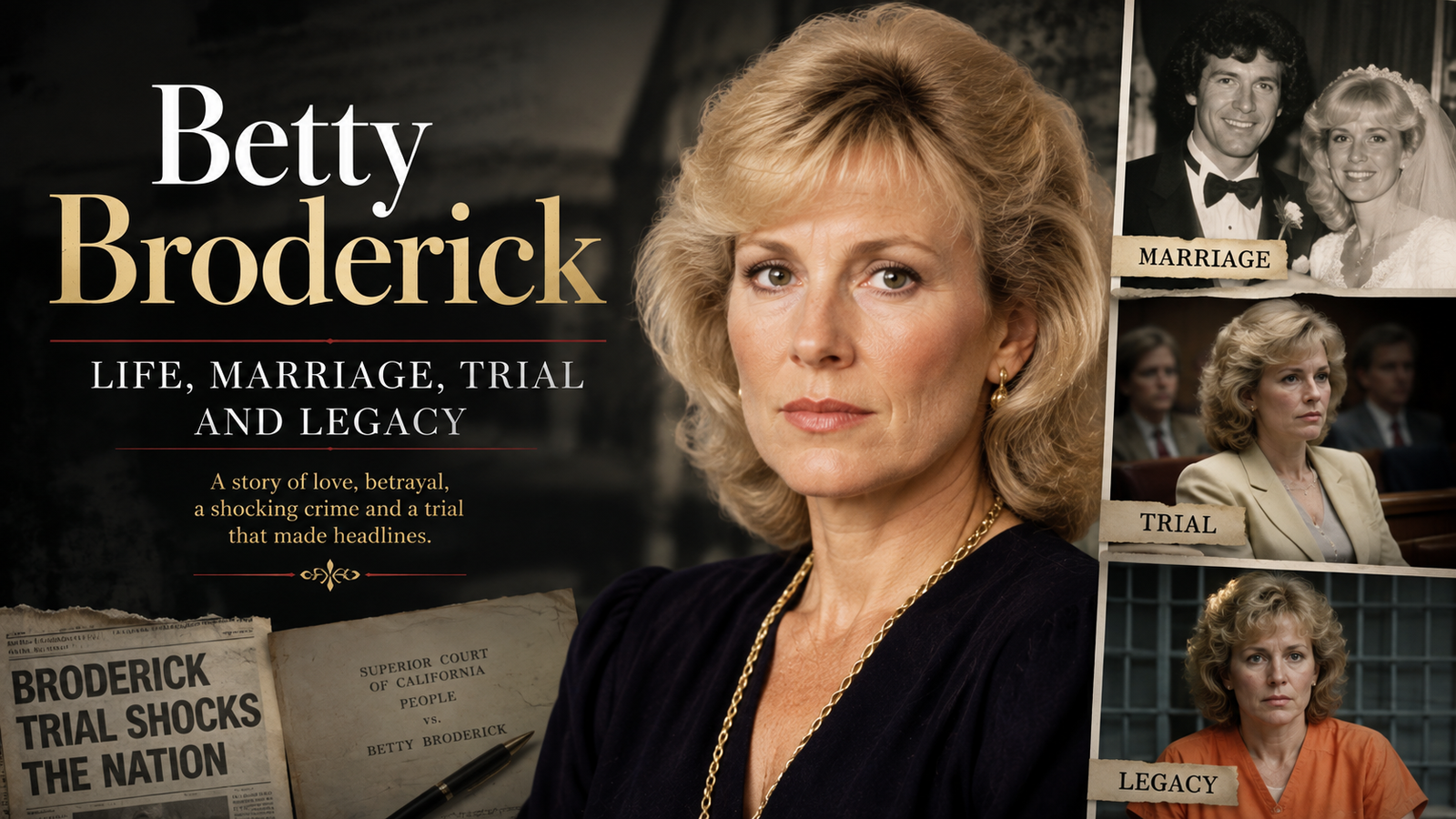
Betty Broderick: Life, Marriage, Trial and Legacy
Betty Broderick became one of the most recognizable names in American true crime after the 1989 killings of her former husband, Dan Broderick, and his new wife, Linda Kolkena. The case attracted extraordinary public attention because it combined a bitter divorce, disputes over money and custody, allegations of infidelity, escalating conflict, and a courtroom battle that divided public opinion.
But Betty Broderick’s story began long before the murders. Born Elisabeth Anne Bisceglia in 1947, she grew up in New York, married Dan Broderick in 1969, and eventually became a mother of four while her husband built a successful legal career in San Diego. Their marriage later deteriorated into a highly contentious divorce that lasted several years.
The resulting criminal case raised difficult questions about responsibility, emotional distress, domestic conflict, revenge, and the limits of personal grievance as a defense against violent crime.
This article examines Betty Broderick‘s life, marriage, divorce, criminal case, conviction, imprisonment, family relationships, and cultural legacy while distinguishing documented facts from the competing interpretations surrounding her story.
Key Takeaways
- Betty Broderick was born Elisabeth Anne Bisceglia on November 7, 1947, in New York.
- She married attorney Dan Broderick in 1969, and they eventually had four children.
- Their marriage deteriorated during the 1980s amid allegations of infidelity and a bitter divorce and custody dispute.
- On November 5, 1989, Betty shot and killed Dan Broderick and his new wife, Linda Kolkena, in their San Diego home.
- Her first murder trial ended without a verdict, but she was convicted of two counts of second-degree murder at a second trial in 1991.
- She was sentenced to 32 years to life and remained incarcerated until her death in May 2026.
- Betty Broderick died at age 78 on May 8, 2026, after being transferred from prison to a medical facility.
Biography Table
| Detail | Information |
|---|---|
| Full Name | Elisabeth Anne Bisceglia, commonly known as Betty Broderick |
| Date of Birth | November 7, 1947 |
| Age | 78 at the time of her death |
| Birthplace | Eastchester, New York, U.S. |
| Nationality | American |
| Profession | Homemaker and later nationally known criminal defendant |
| Education | Mount Saint Vincent College |
| Years Active | Primarily known publicly from the 1980s through 2026 |
| Known For | The 1989 killings of Dan Broderick and Linda Kolkena and the subsequent trials |
| Major Achievements | No conventional professional achievements; became the subject of extensive books, television productions and true-crime coverage |
| Estimated Net Worth | Not reliably established |
Main Article
Who Was Betty Broderick?
Betty Broderick was an American woman whose life became the subject of one of the most heavily discussed criminal cases in late-20th-century California.
She was born Elisabeth Anne Bisceglia on November 7, 1947, and grew up in Eastchester, New York, in a large Catholic family. As a teenager, she attended Mount Saint Vincent College. During a 1965 trip to the University of Notre Dame, she met Daniel “Dan” Broderick III.
The couple married on April 12, 1969. Dan eventually pursued a legal career, and the family moved to San Diego in 1973 after he completed his studies at Harvard Law. Betty became primarily responsible for the household and their children as Dan developed his professional career.
For years, their lives appeared to follow a conventional path toward financial and professional success. That picture changed dramatically during the 1980s.
Betty Broderick and Dan Broderick’s Marriage
Betty and Dan Broderick married when they were relatively young. Their early years involved financial pressure and significant educational ambitions.
According to accounts of the relationship, Betty worked and supported the household while Dan pursued his education and career. They eventually raised four children together.
Their family later settled in the San Diego area, where Dan established himself as a prominent attorney specializing in medical malpractice.
The relationship became increasingly troubled as Dan’s career progressed.
The Role of Linda Kolkena
A major turning point came when Dan hired Linda Kolkena as a legal assistant.
Betty suspected that Dan and Kolkena were having an affair. Accounts of the case differ in how various events unfolded and how each person interpreted the relationship, but the alleged affair became central to Betty’s understanding of the marriage’s breakdown.
Dan separated from Betty in 1985, and he filed for divorce later that year. The separation did not bring an end to their conflict. Instead, their disagreements over property, finances, custody and personal relationships became increasingly intense.
The Broderick Divorce
The divorce became one of the defining chapters of Betty Broderick’s life.
The proceedings were highly contentious and attracted attention even before the later criminal case. Contemporary reporting described disputes involving property, financial support and custody of the couple’s four children.
The divorce was finalized in July 1986, with Dan receiving sole custody of the children.
However, legal separation did not end the dispute.
Financial and Custody Conflicts
Money was an especially important issue.
Betty argued that she deserved greater financial support and believed the division of the family’s assets did not adequately reflect Dan’s earnings or her contribution to the household.
The disagreement was not simply about a monthly payment. It reflected a much broader conflict over the value of Betty’s role in the marriage, Dan’s professional success, and the financial consequences of their separation.
Custody was equally significant.
The loss of primary custody deeply affected the family dynamic, and the children became caught between their parents during a prolonged period of hostility.
Escalation After the Divorce
The conflict between Betty and Dan continued after the divorce.
Accounts of the period document repeated confrontations, threatening messages, property damage and violations of court orders. One particularly dramatic incident involved Betty driving her vehicle into the front entrance of Dan’s new home.
These incidents became important during the eventual murder prosecution because prosecutors used them to establish a pattern of escalating hostility toward Dan and Linda.
Betty, however, presented her own interpretation of the events. She maintained that she had been subjected to prolonged emotional and psychological mistreatment and that Dan’s professional position gave him an advantage during their divorce.
Understanding those competing perspectives is important when examining the case. The existence of serious marital conflict does not itself establish a legal justification for violence, and Betty’s later conviction reflected the jury’s assessment of the criminal charges brought against her.
The 1989 Murders
On November 5, 1989, Betty Broderick went to the San Diego home of Dan Broderick and Linda Kolkena.
She entered the residence and went to their bedroom, where she shot both of them.
Dan and Linda died in the attack. Betty subsequently surrendered to police. Contemporary reporting and later accounts established November 5, 1989, as the date of the killings.
The murders immediately transformed the Broderick divorce from a widely followed family dispute into a nationally discussed criminal case.
The fact that Betty had previously made threats and engaged in confrontational behavior also became significant to the prosecution’s presentation of the case.
Why the Betty Broderick Case Became So Controversial
The case generated intense debate because people interpreted the same history in dramatically different ways.
Some viewed Betty primarily through the lens of a woman who had endured a devastating marriage breakdown, alleged betrayal and years of conflict before committing the killings.
Others focused on the documented escalation in her conduct, including threats, harassment, property damage and violations of court orders, arguing that these actions demonstrated a dangerous fixation on her former husband.
The criminal justice system ultimately had to address a narrower question: whether Betty was legally responsible for the deaths and, if so, what degree of murder applied.
That distinction matters.
A person’s difficult circumstances can provide context without eliminating criminal responsibility.
Betty Broderick’s First Trial
Betty’s first murder trial began in 1990.
The prosecution and defense presented competing interpretations of her mental state and intentions. The defense sought to portray her actions in the context of prolonged emotional turmoil, while prosecutors argued that the killings represented intentional acts.
The first jury was unable to reach a unanimous verdict.
The result was a mistrial rather than an acquittal. Historical accounts describe the jury as divided over whether Betty should be convicted of murder or a lesser offense.
The case therefore went to trial again.
The Second Trial and Conviction
Betty Broderick was retried in 1991.
The second jury convicted her of two counts of second-degree murder. In 1992, she received a sentence of 32 years to life in prison.
The conviction was significant because the jury did not find her guilty of first-degree murder, but it also rejected the idea that the killings should be treated as justified or excused.
Her sentence consisted of two consecutive 15-years-to-life terms, along with additional time related to firearm use, according to accounts of the case.
What Happened to Betty Broderick in Prison?
After her conviction, Betty Broderick spent decades incarcerated in California.
Her case continued to attract public interest because of interviews, books, documentaries and television productions based on the story.
She also became known for her continued efforts to obtain parole.
Her first major parole request was denied in 2010, and another request was denied in 2017. Reporting on those proceedings indicated that the parole board considered issues including remorse and accountability.
Betty maintained her own interpretation of the killings and continued to dispute aspects of the narrative surrounding her case.
Betty Broderick and Her Children
Betty and Dan had four children: Kim, Lee, Daniel Jr. and Rhett.
The children experienced the consequences of the divorce and the later murders in profoundly different ways.
Their views of their mother also varied. Some expressed support for her release at different points, while others were more critical of her actions or opposed parole.
That division illustrates one of the most difficult aspects of the case: Betty Broderick was not simply a criminal defendant in the lives of her children. She was also their mother, while Dan was their father.
The family’s experience therefore cannot be reduced to a simple question of whether someone was entirely sympathetic or entirely unsympathetic.
Betty Broderick’s Death in 2026
Betty Broderick died on May 8, 2026, at the age of 78.
She had remained incarcerated at the California Institution for Women in Chino, California. On April 18, 2026, she was transferred to an outside medical facility for a higher level of care. She died several weeks later.
Reports following her death said she had experienced a serious fall and subsequent medical complications. Her death was reported as resulting from natural causes.
Her death marked the end of more than three decades of incarceration following the 1989 killings.
Betty Broderick’s Cultural Legacy
The Betty Broderick case has remained part of American true-crime culture for decades.
Its continuing appeal stems partly from the unusual combination of elements involved:
- A highly contentious divorce
- A prominent attorney and his former wife
- Allegations of infidelity
- Custody disputes
- Financial conflict
- Escalating harassment and threats
- A double homicide
- Two criminal trials
- A sharply divided public reaction
The story has been adapted and revisited through television movies, documentaries, books and scripted television.
One of the most prominent modern dramatizations was Dirty John: The Betty Broderick Story, which introduced the case to another generation of viewers.
These adaptations have also created an important distinction between historical fact and dramatized storytelling.
Fact vs. Fiction in Betty Broderick’s Story
Because the case has inspired entertainment productions, readers should be cautious about treating every scene in a dramatization as a documented event.
Television adaptations may compress timelines, combine characters, change dialogue or emphasize particular interpretations.
For a factual understanding of Betty Broderick, the most important sources are contemporary reporting, court records, trial coverage and documented statements rather than dramatized portrayals.
This distinction is especially important in a case where public opinion has often been shaped by competing narratives.
Why the Case Still Matters
The legacy of Betty Broderick is not simply the story of a notorious crime.
The case also demonstrates how prolonged family conflict can become intertwined with the legal system, financial disputes, custody battles and public perceptions of victimhood and responsibility.
At the same time, it is important not to romanticize the circumstances surrounding the killings.
The divorce may provide context for understanding Betty’s behavior, but context and justification are not the same thing. Two people lost their lives, four children lost their parents in different ways, and a family conflict became a criminal tragedy.
That complexity is one reason the case has remained relevant for so long.
Frequently Asked Questions
Who was Betty Broderick?
Betty Broderick was an American woman who became nationally known after killing her ex-husband, Dan Broderick, and his new wife, Linda Kolkena, in San Diego in 1989. She was convicted of two counts of second-degree murder in 1991.
When was Betty Broderick born?
Betty Broderick was born Elisabeth Anne Bisceglia on November 7, 1947, in Eastchester, New York.
Who was Betty Broderick’s husband?
Her husband was Daniel “Dan” Broderick III, a prominent San Diego attorney. They married in 1969 and had four children together.
What happened to Dan Broderick and Linda Kolkena?
On November 5, 1989, Betty went to their San Diego home and shot both of them. They died in the attack.
Was Betty Broderick convicted?
Yes. Her first trial ended in a mistrial after the jury failed to reach a unanimous verdict. At her second trial in 1991, she was convicted of two counts of second-degree murder.
How long was Betty Broderick sentenced to prison?
She was sentenced to 32 years to life in prison in 1992. She remained incarcerated until her death in 2026.
Did Betty Broderick ever get parole?
No. Her parole requests included hearings in 2010 and 2017, but she was not released.
When did Betty Broderick die?
Betty Broderick died on May 8, 2026, at age 78, after being transferred from prison to an outside medical facility.
Conclusion
Betty Broderick’s life became defined by a tragic progression from marriage and family life to divorce, escalating conflict, murder, imprisonment and decades of public scrutiny.
Her relationship with Dan Broderick deteriorated during the 1980s, eventually producing one of California’s most closely followed divorce disputes. The killings of Dan and Linda Kolkena in 1989 transformed that private conflict into a nationally known criminal case.
Betty’s first trial ended without a verdict, but her second trial resulted in two second-degree murder convictions and a sentence of 32 years to life. She spent the remainder of her life in prison and continued to attract public attention through parole proceedings and media portrayals.
Betty Broderick died in May 2026 at age 78. Her story remains a complicated case study in divorce, family conflict, criminal responsibility and the way sensational cases can become part of popular culture. The most responsible way to understand her legacy is to acknowledge the competing perspectives surrounding her life while keeping the documented facts of the crimes and convictions at the center.












Leave a Reply